For many founders and business owners, the first time they seriously consider their capital structure is also the moment they need to act. The urgency makes the debt vs. equity decision harder than it needs to be.
In short, debt financing means borrowing money that you repay with interest while keeping ownership of your business. Equity financing means selling a share of your business to an investor in exchange for capital, generally with no fixed repayments but with shared ownership and, often, shared control.
Getting it wrong is costly. The wrong structure can strain cash flow, dilute ownership unnecessarily, or saddle your business with covenants that constrain future decisions. Getting it right, on the other hand, creates a foundation for the next phase of your company’s growth.
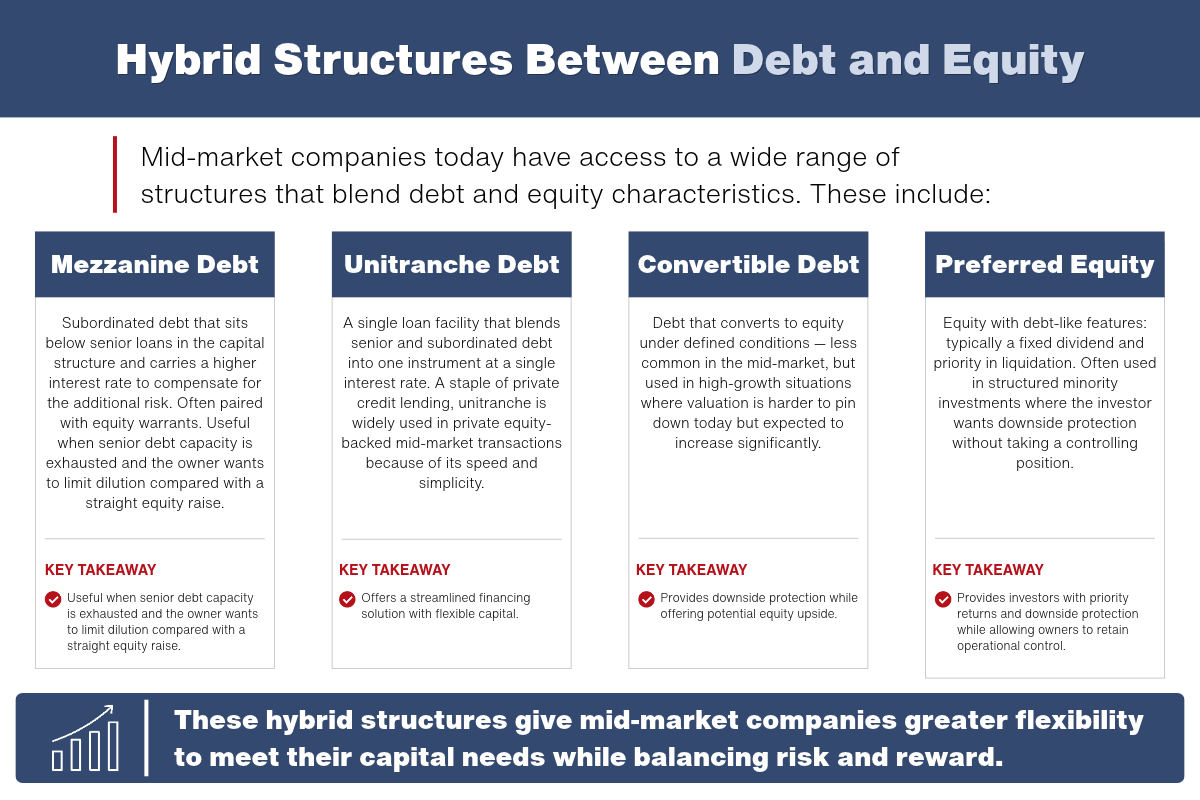
This guide walks through the core trade-offs between debt and equity financing, the hybrid structures mid-market companies use most often, and the questions that drive the decision, whether you’re raising growth capital, funding an acquisition, or planning a partial exit.
The Core Trade-Off: Control vs. Flexibility
At its simplest, the debt vs. equity decision comes down to two competing priorities: control and flexibility.
Debt lets you keep ownership. You borrow money, you pay it back with interest, and with straight senior debt (a conventional business loan that is repaid ahead of other borrowing), you still own 100% of your business when the loan is retired. The cost is cash flow: debt requires scheduled payments regardless of how the business is performing. In a bad quarter or a market downturn, those obligations don’t disappear. Lenders will also typically take security over company assets, set financial covenants, and may require personal guarantees, all of which limit flexibility.
Equity brings in a partner who shares the upside and the risk. Equity investors generally don’t require fixed payments (structured instruments such as preferred equity are an exception), which preserves cash flow flexibility. They own part of your business, and depending on the structure, they may have rights over strategic decisions, board composition, or exit timing.
Neither is inherently superior. The right answer depends entirely on your business’s cash generation, your growth plans, and your personal goals as an owner.
When Does Debt Financing Make Sense?
Debt financing, whether a bank loan or a facility from a private credit fund, works best when your business generates consistent, predictable cash flow. Lenders aren’t venture capitalists. They want to know they’ll get paid back. If your EBITDA (a common measure of operating profit) is stable and your revenue isn’t highly cyclical, debt is typically the lower-cost form of capital, because lenders rank ahead of equity holders and interest is generally tax-deductible. The trade-off is fixed obligations and covenants.
Common debt scenarios include:
- Acquisition financing: using leverage to acquire a competitor or add-on business.
- Growth capital: funding a new location, equipment, or hiring ahead of revenue.
- Balance sheet restructuring: changing your mix of debt and equity to lower your cost of capital or return cash to shareholders.
- Refinancing: replacing existing debt on better terms as conditions improve.
The key question is coverage: does your business generate enough free cash flow, after capex, taxes, and working capital, to cover debt service comfortably, with room for downside scenarios? Lenders will model this carefully, at FOCUS we apply the same level of scrutiny to build a robust case on your behalf.”
When Does Equity Financing Make Sense?
Equity financing, whether from a private equity firm, a growth equity investor, or a strategic partner, becomes the right tool in several situations:
- Your business doesn’t generate enough cash flow to support meaningful leverage.
- You’re in a high-growth phase where cash needs to stay in the business.
- You want a capital partner who brings industry relationships, operational expertise, and acquisition support.
- You want to take some money off the table now while retaining a meaningful stake in future upside.
Consider one example from our own work at FOCUS. The two founders of an e-commerce business wanted to acquire a new brand for their portfolio and planned to fund the deal with debt. As we prepared to take the deal to market, it became clear that the seasonality of their revenue would make it hard for lenders to get comfortable. Early conversations with lenders confirmed this, so we changed course: the acquisition was funded with equity, with a view to raising debt later, once the enlarged group had more stable revenue.
How to Choose Between Debt and Equity: Key Questions to Ask
In practice, a good corporate finance advisor will work through a structured set of questions with you before recommending a structure. The most important ones:
- What is your current EBITDA, and how stable is it from one year to the next?
- What do you need the capital to accomplish, and over what timeframe?
- How much leverage does your business currently carry?
- Do you have a defined exit horizon or are you building indefinitely?
- How important is retaining full operational control rather than accessing a strategic partner?
- Are there personal liquidity needs that should factor into the structure?
The answers to these questions often point clearly toward one structure or another. Where they don’t, the advisor’s job is to model the scenarios and help you see the downstream consequences of each choice.
Common Misconceptions About Debt and Equity
Three misconceptions often come up in these conversations.
- The first is that equity is the cheaper way to fund growth because there are no repayments. In reality, it is usually the most expensive capital a business can raise: investors expect returns well above a lender’s interest rate, and they take them from your exit value rather than your monthly cash flow.
Let’s take an example from our previous work of with a manufacturer that supplies supermarkets and grocery retailers. Facing rising demand, the owners wanted to raise equity to fund the extra working capital needed to take on more orders. They assumed debt would be too expensive and that investors would value the business on its forecast revenue and strong pipeline. When we worked through their funding requirements however, two things became clear. Investors were unlikely to pay the valuation the owners hoped for on forecasts that ambitious, and the business’s stable cash flow made it well suited to debt. Instead of selling a share of the company for a single lump sum, the owners could use a package of debt facilities from an asset-based lender: drawing down more funds as the business grew, repaying them from the cash it generated, and keeping full ownership.
Instead we found a flexible, creative lender that tailored those facilities to the business’s needs: a term loan to refinance existing debt and repay shareholder loans; an asset finance and leasing facility to buy new equipment that would speed up production and automate more of the process; a new invoice finance facility with a higher limit to support growth; and an inventory revolving facility to fund raw materials for new orders.
- The second misconception is that if the bank says no, debt is off the table. Mainstream banks are only one part of the lending market. Private credit funds, asset-based lenders, and specialist providers of invoice, inventory, and equipment finance often lend where a bank won’t, and on more flexible terms, as the manufacturer’s facility package shows. The trade-off is usually a higher price.
- The third is that the headline valuation is all that matters. Two offers at the same valuation can be worth very different amounts to an owner once liquidation preferences, ratchets, board seats, veto rights, and earn-outs are taken into account. That is why it pays to compare the full terms of each offer, not just the price.
How FOCUS Helps Business Owners Raise Capital
FOCUS advises founders and mid-market business owners on raising capital across the full capital structure, from senior debt and private credit to minority and majority equity investments. Our approach begins with a candid assessment of your business and your goals, not with a predetermined preference for one structure over another.
We run competitive processes with multiple capital sources simultaneously to show you what capital is available in the market, not just what one lender or investor is willing to offer. That competitive tension gives you a market-based view of pricing, terms, and the structures best aligned with where your business is headed.
Ready to explore your funding options? Contact FOCUS to speak with an advisor.